
The offer exists. It sits there, barely touched.
More of your people are asking for help than ever, and fewer of them are getting it. Across UK workplaces, demand for counselling has risen while actual access has fallen. Most employers with an Employee Assistance Programme see three to five per cent of staff use it in a year. The provision exists. It sits there, well-meant, and barely touched.
The usual response is to raise awareness, another poster, another email with the number on it. It doesn't move, because the barrier was never that people don't know the number. They know it. They don't call.

A person reaches for help only when reaching feels safe.
For many it doesn't, and often for good reason: somewhere, a disclosure came back as a mark on a record, a vulnerability named to a manager resurfaced in a review, a request for support became the thing held against them. For that person, a helpline number is not a neutral offer. It is a stranger to phone at the worst moment, through a door they have already learned can be used against them.
This is why the quality of how support is offered matters as much as whether it is offered at all. Support that is cheap, poorly bounded, or run from inside the management chain is not simply less effective. For the people who most need it, it can confirm every reason they had for never trusting workplace support again.

Someone they already know.
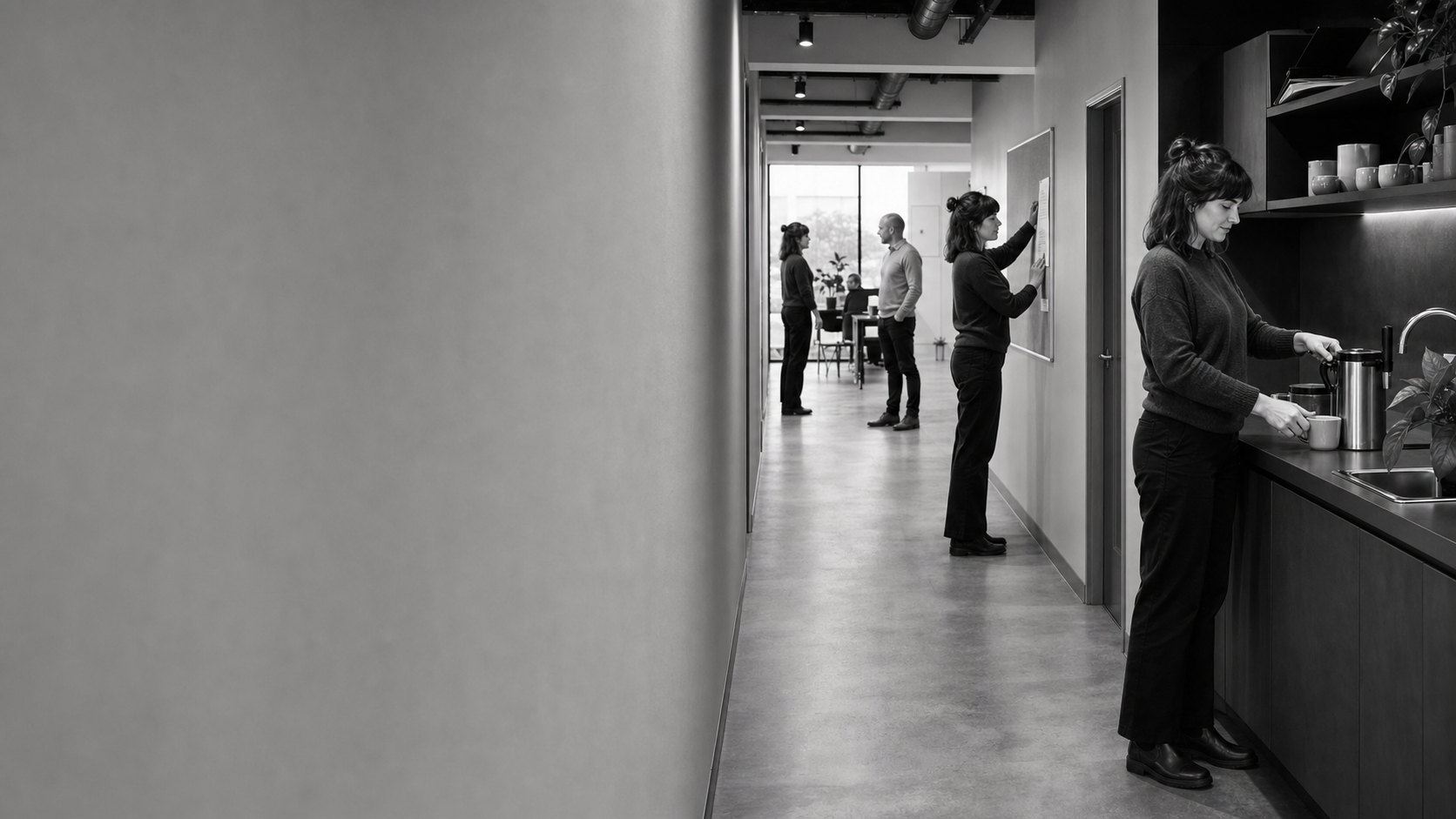
The single thing that moves early help-seeking is a practitioner who is already known. Met in a workshop, seen in the ordinary run of the week, recognised as a person rather than a number on a card, so that making contact costs a fraction of what it costs to approach a stranger at the point of greatest difficulty.
That is the whole shape of this. A practitioner present in the life of the organisation, working across the themes that genuinely move workplace wellbeing. Delivered through workshops that build relationship rather than deliver training, low-stakes ways in that don't require anyone to call themselves broken, and properly held confidential work for those who go deeper.
The themes the work moves across
-
 The change happens either way. How it lands in the people is the buildable part.
-
 The people an organisation can least afford to lose are the ones a poster with a number on it never reaches.
-
 Burnout is visible late. It is met earliest by someone present before the crisis, and that presence is buildable.
-
 The costliest difficulties in an organisation are relational, invisible on any dashboard, and workable.
-
 Most resilience programmes train endurance. This is about the conditions that let people recover.
-
 One of the highest-risk moments an organisation handles, and one of the least seen.
Independent of the chain. Honest about the limits.
The practitioner sits entirely outside the line-management chain, with no authority over anyone they see, over their record, their work, their job. That independence is what makes confidentiality believable rather than merely promised, and it is the line that does not move.
And it will not pretend to do what it cannot. No support model can out-counsel a workplace that is structurally unsafe, and a practitioner who is honest will say so rather than absorb the problem quietly and let it run. That honesty is not a disclaimer. It is the thing that makes everything else trustworthy.

A standard programme counts its crisis calls. Five hundred calls is five hundred preventions that came too late. Before it is a number, be the prevention.
The measures that mean prevention is actually happening.
This model looks the other way from the crisis count: at how early people come forward, at whether the gap between difficulty and asking for help is narrowing, at engagement that happens before performance drops. These are harder to put on a dashboard, and they are the only measures that tell you the prevention is actually happening.
You'll get the trend and the human account of it. You will not get a promised number, because the crisis that was quietly averted cannot be counted, only built toward.

The good can finally be kept lit.
A steady place is what makes the point possible.
Under sustained pressure, the first thing to go is not competence. People keep delivering long after something quieter has shut down: the capacity to think freely, to be genuinely in contact with the work and with each other, to let a good day actually land. That capacity goes first and comes back last, and most workplaces never notice it has gone, because the output holds.
What returns when the ground is steady is not just relief. It is the part of a person that brings something of their own to the work, that has an idea worth having, that can take a real interest, that can be met and be changed by it. The people who have spent years being valued only for what they produce are often the ones who have quietly lost the ability to receive anything back. Good work lands and does not stay. Recognition arrives and is deflected. They have become very good at producing and have nowhere to put what comes in.

That is not fixed by telling anyone to think positive or to look after their wellbeing. It is the opposite of that. It is met by making a place safe enough that the guard against good experience is no longer needed, so that a person can let the work be interesting again, let a good week be a good week, and bring the part of themselves that pressure had taught them to keep offline.
That is what the ground is for. Not just people who are steadier. People who are more alive to the work, and more themselves in it.
Not workshop titles bought off a shelf.
The themes above are not workshop titles bought off a shelf. Each is backed by genuine clinical depth, developed over years, brought into the organisation in plain language without the earnestness or the jargon.
I'm a UKCP-registered psychotherapeutic counsellor with more than twenty years in residential mental health and addiction services, and a Workplace Wellbeing Consultant working with organisations that want more than a number on a card.
If your provision is well-meant and barely used, that is worth a conversation.
Known before they need you.
Tell me where your provision sits, and we'll start with a conversation.